How to choose someone to fix an AI-built app (Lovable, Replit, Bolt)
Your Lovable, Replit or Bolt app is stuck or unsafe? What a good review must check, what to ask a helper before you pay, and the warning signs.

In May 2025, security researchers read the users table of a Lovable app called Linkable and wrote "payment_status": "paid" into it. Stripe never saw a payment. The database had no rule to stop them (Matt Palmer, CVE-2025-48757).
Problems like this are common in AI-built apps (Escape.tech). A good helper finds them before writing any code. This guide is for founders whose app was made with Lovable, Replit, Bolt, Base44, v0 or Cursor and now needs a person. I run a company that does this work, so I am not a neutral judge. Use this list on us too. Our own page is fix, secure and finish your AI-built app.
What a good review of an AI-built app must cover
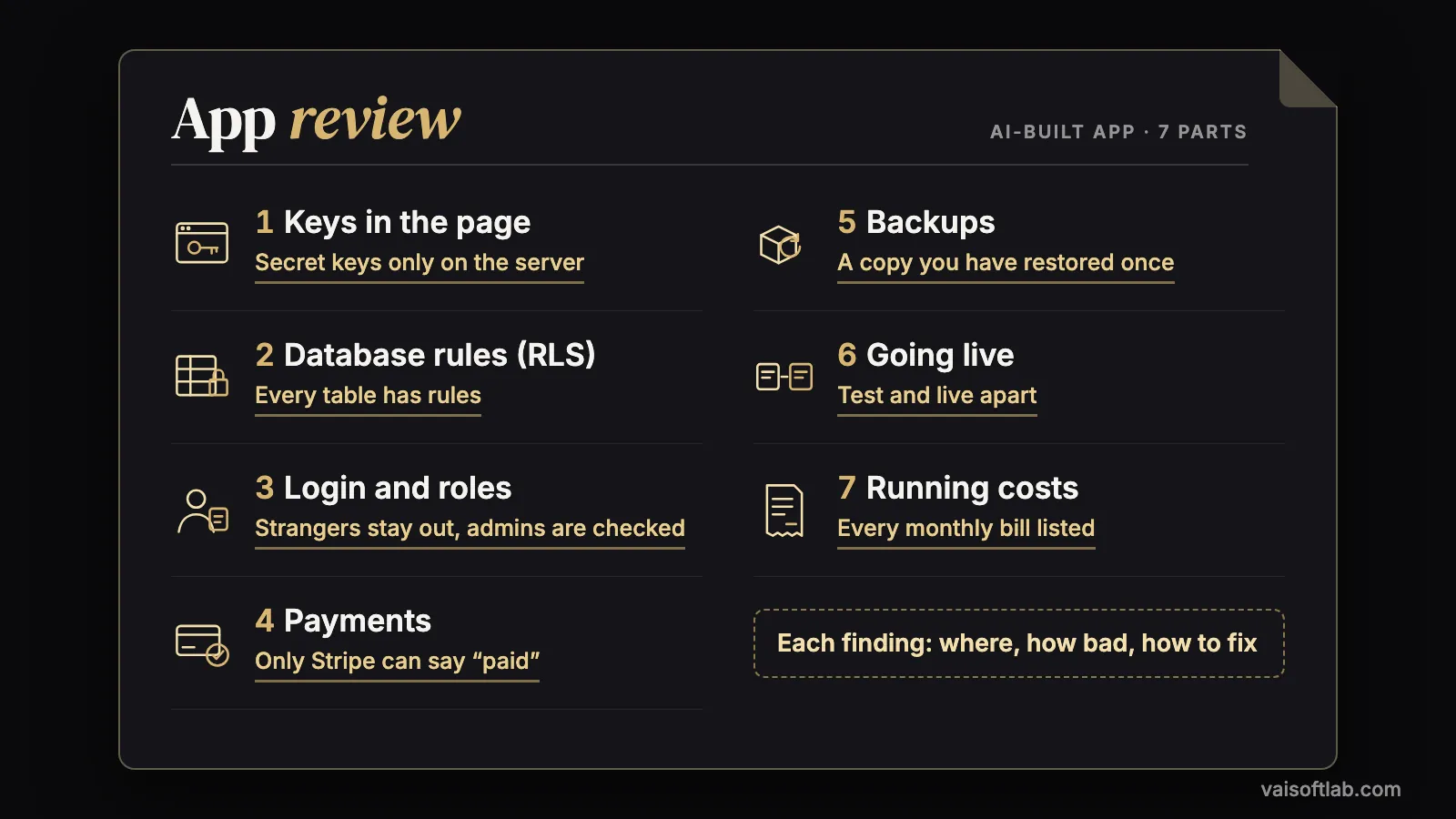
A review is a written list of problems, each with where it is, how bad it is and how to fix it. Ask for it before any fix starts. It should cover these seven parts.
1. Keys in the page
Anyone can read what an app sends to the browser. Lovable’s docs say keys “cannot be stored safely in client-side code”. A Supabase publishable key is made to be public. A secret key (sb_secret_... or the old service_role) “bypasses RLS” and must stay on a server (Supabase API keys), like keys for OpenAI, Stripe or email. In October 2025, Escape.tech scanned about 5,600 public vibe-coded apps and found more than 400 exposed secrets.
Ask: “Which keys are in my front end (the code that runs in the browser), and which of them are secret?”
2. Database rules (Supabase RLS)
RLS (row level security) is the rule on each table that says who may read or change each row. Supabase: “A table in an exposed schema without RLS is readable and writable by any role with a grant on it”. In the 2025 scan of 1,645 Lovable apps, about 1 in 10 had weak rules. In February 2026, Wiz found about 1.5 million API tokens open in Moltbook’s database. The key in its page was the normal public one; the missing rules let anyone in.
Ask: “Show me each table, its rules, and a test where user A tries to read user B’s data.”
3. Login and roles
Login proves who someone is. Roles decide what they may do. In February 2026, an AI-written check in a Lovable-hosted app worked the wrong way round: it blocked logged-in users and let strangers in. 18,697 user records were open. Broken access control is still number 1 on the OWASP Top 10 for 2025.
Ask: “Who can sign up, who is an admin, and where in the code is that checked?”
4. Payments
Stripe tells your app “this person paid” with a webhook, a message to your server. Stripe’s docs: without checking its signature, “an attacker could send fake webhook events to your endpoint to trigger actions like fulfilling orders, granting account access or modifying records”. Stripe can also send one event twice, so count each one once.
Ask: “Where is ‘paid’ written, and can a user write it themselves?”
5. Data backups
On Supabase, daily backups start on the Pro plan and keep 7 days; on the Free plan you export the data yourself with db dump. Replit keeps 7 days of production history on Core and up to 28 on Pro. In July 2025, a Replit agent deleted a live database during a test by SaaStr founder Jason Lemkin, after it was told to make no changes without approval. The agent said a rollback was impossible; the data came back anyway.
Ask: “When was the last backup, and have you tried a restore?”
6. Going live
Test data and live data should sit in different places. Replit has separate development and production databases, and a code rollback does not touch the live one (Replit data recovery). Lovable’s export leaves your keys out, so a move means setting each one again.
Ask: “What is different between test and live, and what is the step-by-step plan to go live?”
7. Running costs
List every service that sends you a bill: hosting, database plan, the builder’s credits, AI model calls, email, payments. A leaked AI key can run up a bill for someone else’s use.
Ask: “What will this cost me each month, and what happens when users grow ten times?”
Questions to ask before you pay
| Ask | A good answer sounds like |
|---|---|
| What do you look at first? | What is public: the live app, its page code, the requests it sends. Then a copy, or read-only access. |
| Which of the seven parts will you check? | All seven, with the ones they skip named in writing. |
| Do I get the findings in writing before any fix? | Yes, a list ordered by danger, with a test you can run for each one. |
| Will you fix it in place, or move it off Lovable, Replit or Bolt? | Usually in place first. A move only with a reason you can repeat to someone else. |
| Who owns the code and the accounts when you finish? | You. Every account in your name. Keys changed after they leave. |
Here is how my team works through a job like this.
Access needs care. On GitHub, a helper you add to a personal repository (code store) cannot have read-only access, so move the code to a free organization or share a copy. Supabase’s Read-Only role is only on the Team and Enterprise plans. On a smaller plan, a screen share or an export is safer than your owner login.
Warning signs when you hire a developer to fix a Lovable or Replit app
They want full access on day one. Owner on GitHub, owner on Supabase, live Stripe keys, before they have looked at anything public. A first look needs none of that.
There are no written findings. “I’ll just start fixing” leaves you with no way to check the work, and no way to hand it to the next person.
They say “rebuild everything” before reading the code. Martin Fowler wrote in 2024 about full rewrites: “we’ve seen this simple-sounding plan go down in flames most of the time”. A rebuild can be right. It should come after the review, with reasons.
They promise it will be 100% secure. Lovable’s own docs say its tools “cannot guarantee complete security”.
Fix or rebuild?
| Fix what you have when | Rebuild a part when |
|---|---|
| The screens and the main flow work for real users. | The way data is stored is wrong, for example one table for everything and no owner on rows. |
| The problems sit in the seven parts above. | The same bug comes back after every fix in one area. |
Even a rebuild goes better in pieces: move one area at a time and keep the app live. Article 3 explains why AI-built apps stall at 80%.
AI-written code and security in 2025, 2026 and 2027
| Year | What the numbers say |
|---|---|
| 2025 | Veracode tested 100+ models on 80 tasks: security flaws in about 45% of cases. |
| 2026 | Veracode: the security pass rate is 56%, “virtually unchanged since last year”. Open user data at Moltbook and a Lovable-hosted app. |
| 2027 (my guess) | The builders’ scanners catch more of parts 1 and 2. Parts 3 to 7 still need a person, because they depend on what your business means by “allowed”. |
The code almost always runs; it passes the security test a little over half the time (Veracode 2026). How I check AI-written code before it ships is in my article on checking AI code quality.
Checklist before you hire someone to fix an AI-built app
- 1. Run your builder’s own security scan and save the result.
- 2. Make a backup or export today, before anyone touches the app.
- 3. Write five lines: what the app does, who uses it, what is broken, what must stay, your deadline.
- 4. Ask for a first look at the public app only. No logins yet.
- 5. Get the findings in writing, ordered by danger, covering all seven parts.
- 6. Give the least access that does the job: read-only or a copy first.
- 7. Agree a test for each fix, run on test data first and then live.
- 8. When the work ends, change every key and remove their access.
Questions people ask
Is the free security scan in Lovable or Bolt enough?
Run it first. Lovable’s quick scan checks database rules and packages when you publish, and Bolt’s Security Audit “checks only your database, not your whole project” (Lovable, Bolt). Lovable itself says these tools “do not replace a thorough security review”.
Is it safe that my Supabase key is visible in the browser?
The publishable (or old anon) key is made to be public, as long as every table has RLS rules (Supabase). The secret (or old service_role) key must never be in the browser. If it was, change it now.
Can I keep using Lovable, Replit or Bolt after a developer fixes my app?
Usually yes. Lovable syncs with GitHub both ways, so a developer can fix code in GitHub and you keep building in Lovable (Lovable).
What should a first look include?
The three biggest problems, in writing, with where each one is and why it matters. A first look needs only your app’s public address.
Have an app idea, a stuck app, or a daily job you want an AI agent to do?
Write three lines. I reply within one working day with a plain answer.
Sources. Lovable docs: Security; FAQ, Code export. Supabase docs: Row Level Security, API keys, Database backups, Access control. Replit docs: Data recovery, Checkpoints and rollbacks. Bolt support: Database security. Stripe docs: Webhooks. GitHub docs: Permission levels for a personal account repository. OWASP Top 10:2025, A01. Matt Palmer, statement on CVE-2025-48757 (29 May 2025). Escape.tech, vibe-coded apps study (29 Oct 2025). Wiz, “Hacking Moltbook” (2 Feb 2026). The Register (27 Feb 2026). eWeek and TechTarget on the SaaStr Replit incident (Jul 2025). Veracode GenAI Code Security Reports (30 Jul 2025; 28 Jul 2026). Martin Fowler, “Strangler Fig” (22 Aug 2024). All read 26 Oct 2026.


